The Writer’s Block: “Authoring Your Story”

How does one gain access to one’s own life, to think about or even write about one’s own experiences? How does one find the language to articulate the being of his/her experiences? Can language capture the being or content of our experiences? Or, does it, in some way, only hope to capture merely our own perspective.
– Excerpt From “Black Boy: Phenomenology and the Existential Novel” by James B Haile

Thoughts?

Leave a comment

Filed under The Writer's Block

Poem of the Month: “An African Elegy”

“We are the miracles that God made
To taste the bitter fruit of Time.
We are precious.
And one day our suffering
Will turn into the wonders of the earth.

There are things that burn me now
Which turn golden when I am happy.
Do you see the mystery of our pain?
That we bear poverty
And are able to sing and dream sweet things

And that we never curse the air when it is warm
Or the fruit when it tastes so good
Or the lights that bounce gently on the waters?
We bless things even in our pain.
We bless them in silence.

That is why our music is so sweet.
It makes the air remember.
There are secret miracles at work
That only Time will bring forth.
I too have heard the dead singing.

And they tell me that
This life is good
They tell me to live it gently
With fire, and always with hope.
There is wonder here

And there is surprise
In everything the unseen moves.
The ocean is full of songs.
The sky is not an enemy.
Destiny is our friend.”

— Ben Okri

1 Comment

Filed under African Lit, For Lovers, Readers and Me

The Philosopher’s Corner: Metaphysics in Morrison’s “Bluest Eye”

Quiet as it’s kept, there were no marigolds in the fall of 1941. We thought at the time, that it was because Pecola was having her father’s baby that the marigolds did not grow. A little examination and much less melancholy would have proved to us that our seeds were not the only ones that did not sprout; nobody’s did…For years I thought my sister was right; it was my fault. I had planted them too far down in the earth. It never occurred to either of us that the earth itself might have been unyielding…What is clear now is that of all that hope, fear, lust, love, and grief, nothing remains but Pecola and the unyielding earth.

            There is nothing more to say—except why. But since why is difficult to handle, one must take refuge in how.

In these lines, right up front, Toni Morrison links the relationship between Pecola and her father to that of the earth and its yielding (of marigolds). Morrison establishes a metaphysical condition as the underlying condition of each relationship, one in the other. What is more, Morrison is telling us, up front, that analyzing Pecola and her situation existentially—that is, analyzing her situation in terms of concepts such as, “hope, fear, lust, love or grief”; or, the more traditional existential cognates of anguish, abandonment, and despair—is not her primary concern; rather, what is of concern, what remains, is the metaphysical connection between “Pecola and the unyielding earth.” What we are left with is not the psychoanalytic explanation of why any of “this life” occurs—the psyche or ego individuated making sense of the world—but the voice of a child engaged with existence connecting the seemingly disparate elements of life—a little girl and the hard black dirt. “We had dropped our seeds in our own little plot of black dirt just as Pecola’s father had dropped his seeds in his own plot of black dirt. Our innocence and faith were no more productive than his lust or despair.” 

What is left when the traditional ‘existential philosophy’ has failed is the metaphysical question: not why, but how—how does anything, anyone come to be who or what they are?

Leave a comment

Filed under The Philosopher's Corner

What She’s Reading

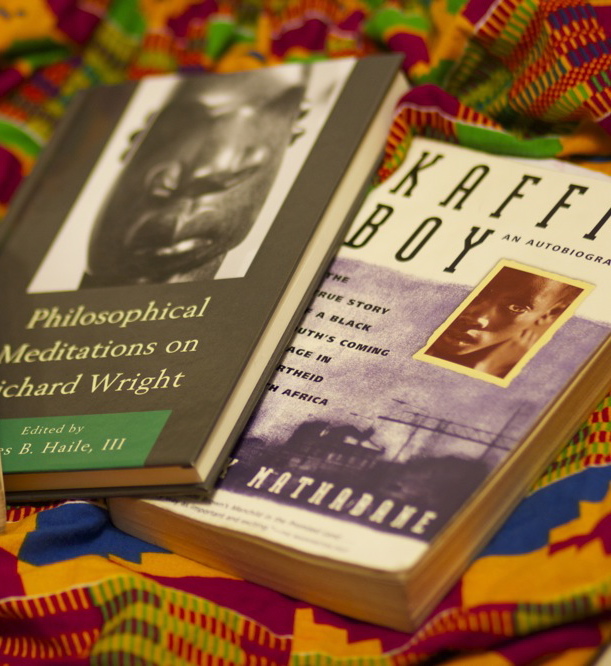
IMG_8413

Kaffir Boy – My never-ending search for auto-ethnographic texts (stay tuned for a post on this in the future), led me to this classic.  Inspired by Richard Wright’s  Black Boy, Kaffir Boy is an autobiographical narrative that explores Mark Mathabane’s childhood during South Africa’s apartheid.  Introspective and analytical, this novel is simply captivating.

Philosophical Meditations on Richard Wright – Written by one of the authors of this blog *winks and looks over at him*, this text explores Richard Wright from a philosophical, psychological, and sociological perspective.  Although this book is written for academics, I found it to be very engaging and even paradigm shifting in terms of perspective on Wright’s work.

Leave a comment

Filed under African Lit, Afro-American Lit, What We're Reading

The Philosopher’s Corner: A Brief Review of Richard Wright’s “Haiku”

In the introduction of the 2012 publication of Richard Wright’s posthumous book, Haiku: The Last Poetry of Richard Wright (Arcade Publishing), Wright’s daughter, Julia, referred to the following as his literary enigma: “how the creator of the inarticulate, frightened, and enraged Bigger Thomas ended up leaving us some of the most tender, unassuming, and gentle lines in African-American poetry.” Wright left some four thousand haiku (only a few hundred published), and the question has been left unanswered: what, if any, is the relationship between his haiku poems and his social/political prose and non-fiction?

I have always been drawn to Wright’s interest in nature, in the mysteries of nature, and how this interest influenced and informed the social and political (perhaps protest) work for which he has become strictly known and infamous. What if we rethought the relation of politics to nature, “realism” to “surrealism” such that these haiku are no longer understood as a side-interest, or the ramblings of a sick man at the end of his life, but as evocative of the meaning of human existence, black existence?

Link to purchase:

1 Comment

Filed under The Philosopher's Corner

10 Great Opening Lines in Afro-Literature

Every great writer knows the importance of the opening text. Not only is it the author’s first shot at engaging the reader, it also sets the tone for the entire novel.  A truly great incipit, as evidenced by the examples below, will also foreshadow theme, structure, plot and even conflict.

Let’s face it, a strong opening is perhaps the best indication of a strong text.  So let’s take a look at a few of the most profound within the Afro-literary genre:

“On the morning of her ninth birthday, the day after Madame Francoise Derbane slapped her, Suzette peed on the rosebushes.” – Lalita Tademy, Cane River

“You better not never tell nobody but God.” – Alice Walker, The Color Purple

“We are on our way to Budapest: Bastard and Chipo and Godknows and Sbho and Stina and me.” – NoViolet Bulawayo, We Need New Names

“A dwelling.” – Nuruddin Farah, From a Crooked Rib

“I was not sorry when my brother died.” – Tsitsi Dangarembga, Nervous Conditions

“124 was spiteful.” – Toni Morrison, Beloved

“Early in the morning, late in the century, Cricklewood Broadway.” – Zadie Smith, White Teeth

“Ships at a distance have every man’s wish aboard.” – Zora Neal Hurston, Their Eyes Were Watching God

“In the beginning there was a river. The river became a road and the road branched out to the whole world. And because the road was once a river it was always hungry.” – Ben Okri, The Famished Road

“They say it came from Africa, carried in the screams of the enslaved; that it was the death bane of the Tainos, uttered just as one world perished and another began; that it was a demon drawn into Creation through the nightmare door that was cracked open in the Antilles.” – Junot Diaz, The Brief Wondrous Life of Oscar Wao

2 Comments

Filed under African Lit, Afro-American Lit, Afro-Caribbean Lit, Afro-European Lit

The Bibliophile: Are You An Addict?

Bibliophile

I found myself relating to more of these posts than I would have liked.  Check them out!  Hopefully someone will assure me that I’m not alone . . .

http://www.buzzfeed.com/summeranne/signs-youre-addicted-to-books-reading

http://www.buzzfeed.com/harpercollins/17-problems-only-book-lovers-will-understand-9npd

http://www.buzzfeed.com/hollymarie/12-signs-youre-really-into-your-book-ee6l

Leave a comment

Filed under The Bibliophile